Showing posts with label NodeMCU. Show all posts

Sunday, March 1, 2020

Web Visitor Counter Revisited - Building a Case for the Counter

Web counter in its new enclosure

A few months back I published a series of posts around the construction of an electronic counter that would provide me with a constant display of the web traffic to this website. 

The counter has been working away for a number of months now with no issues or complaints, well maybe one complaint,,, 

While the counter does work beautifully, it is also just a lump of wires and electronic components that's been sitting on my desk in an unsightly mass. Additionally, the wires have recently become an attractive plaything for some of the furrier members of the household.

Obviously, if I wished to have my new toy to continue to function, I needed to do something.   

In my last post, I did some experimenting with the Cricut Maker, a new tool that we recently got. One of the reasons that I was intrigued by the Maker was that it was capable of making very accurate cuts in thin sheets of plywood. 

After some initial experiments with the Maker, I was ready to try my first project - a proper enclosure for my web counter.  

Sunday, August 25, 2019

Web Page Visitor Counter Part 1 - Using Google Sheets

Counting the Page views

Buoyed with my recent success with my IoT Weather Station, I figured that I should try and up my game, so to speak, and try something a bit more challenging in the IoT arena.

Since I am always curious about what the traffic is on this very site that you are visiting now, I figured that some sort of device that would monitor the pageviews on the site and display the current view count would be a perfect next project on my IoT journey.

Doing some research, I found that it was fairly easy to display view counts for certain sites like YouTube or Instructables.com since those particular sites offer custom API (Application Programming Interface) services that make obtaining that data a relatively simple matter of one or 2 lines of software code on your IoT device.

While on the surface it did seem that making a device to display the page view counts of the website, I quickly discovered that while it is pretty easy to use API calls for those web sites, there are no API's out there that will work for ANY website. 

So clearly I needed to find a way to have my IoT device talk to my website in order to tell me how many visitors.


Sunday, May 26, 2019

Taking The IOT Weather Station Off the Grid

NodeMCU weather station hooked up to a solar charger circuit


A few weeks ago I put together a simple weather station using a NodeMCU based IOT device and a DHT22 temperature module.  I had the device sent its data to a cloud service where I would be able to see what the temperature and humidity were at my house from literally anywhere in the world.

While I was happy in how things turned out in order to power up the station I needed to have it connected to a USB power source.  Since I wanted to have the weather station to be located outside, I needed to find a way to keep it powered up without the need for it to be plugged into a wall socket.,

Since the NodeMCU only requires 5 volts to run, it does make it a perfect candidate to run off a battery. If it can be run off a battery, then that also means that the battery itself can be charged with a solar cell.

Sunday, April 14, 2019

The Internet of Stuff

A couple of small couple of small electronic parts and the world will know how could my home is

As a bit of a departure from my normal posts, I'm going to be getting more into software than softwood, but there will be a woodworking tie in at some point in the future. We just need to lay down some groundwork first.

In recent years, there has been a lot of buzz going on about having what used to be very mundane everyday household items become "smart" by being able to be connected to the internet and communicate with you or with other smart devices.

This concept - more commonly referred to as the "Internet of Things" (or IOT) - has unleashed an avalanche of smart thermostats, front door locks and refrigerators - all with the ability to let you know whether you need milk or that you've left the back door open and now the cat has escaped and is terrorizing the neighborhood.

Being someone who has made a career in the Information Technology field, I was starting to feel a wee bit out of the loop about these things - not a good place to be for any self-respecting IT guy.

I could have just simply read up on IOT devices, but why waste a perfectly good excuse for a bit of puttering in the shop...

As I mentioned in my previous post, you can literally build anything with a little electronic "LEGO". A quick search of the internet showed me many examples of people building their own IOT devices in such a way.

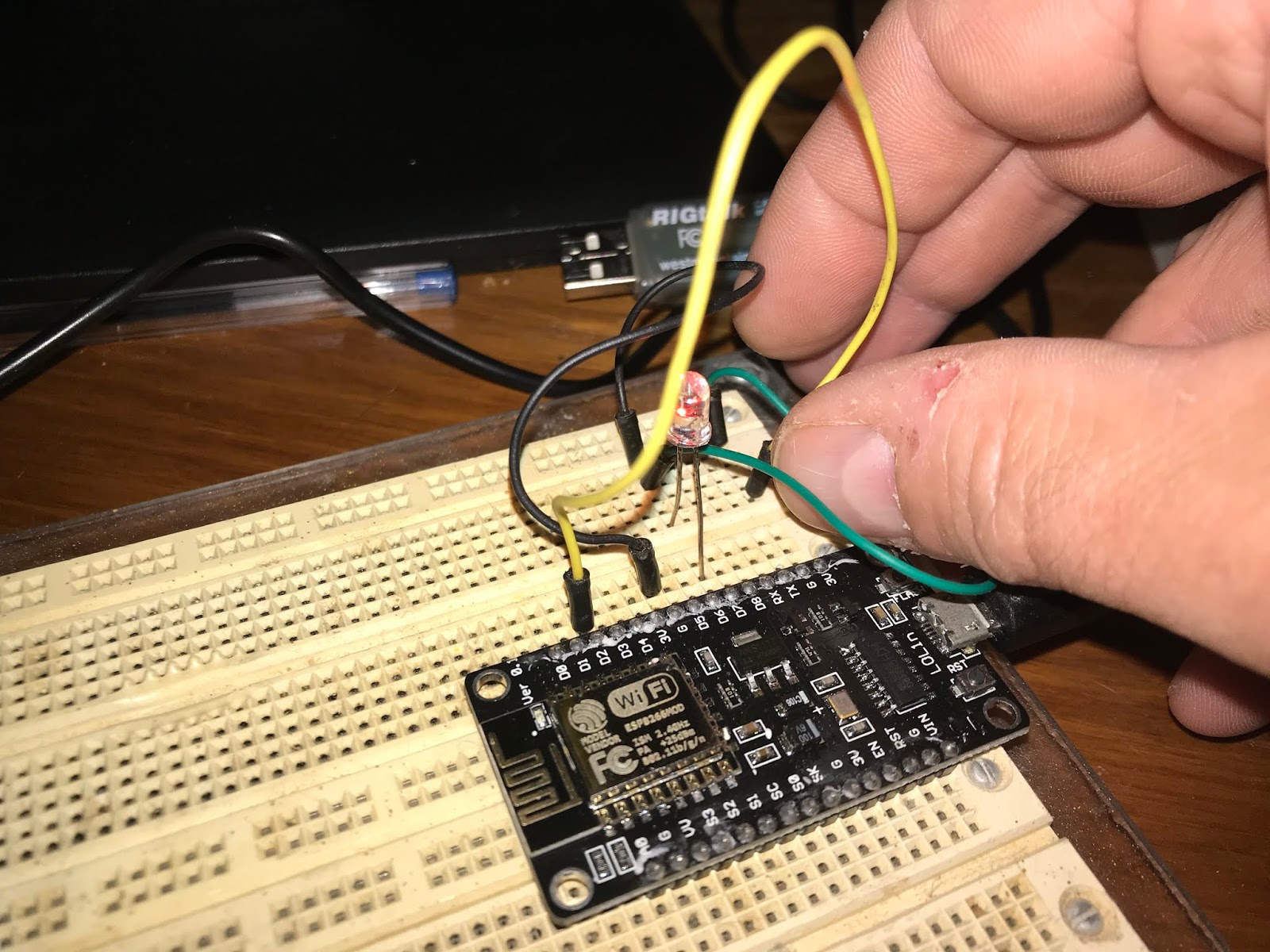
One common thing that I found with these projects was that a lot of them used a small Arduino compatible device based on the ESP8266 board.